
A colleague who has been raising ferrets for ten years received this question three times last month: “And the pygmy weasel, can we have one at home?” The short answer is no in the vast majority of cases.
The pygmy weasel (Mustela nivalis) is making headlines on social media, fueled by videos showing it hunting rodents with fascinating agility. But between the allure of this miniature animal and the reality of domestic cohabitation, the gap is considerable.
Pygmy weasel in captivity: what French regulations prohibit
We start with the point that closes the discussion for most potential adopters. In France, wild mustelids fall under the regime of protected wildlife or classified game. Owning a pygmy weasel requires a certificate of capacity and a prefectural authorization, two documents that are lengthy to obtain and rarely granted to individuals.
This legal framework is not unique to France. Several European countries, notably the Netherlands and Belgium, have tightened their lists of authorized wild species as companion animals since the 2010s. The regulatory trend is clearly towards restriction, not openness. We are therefore talking about an animal that is effectively illegal to own without heavy administrative procedures, and whose online “trend” is based on videos filmed in contexts far removed from the living room of an apartment.
Those who wish to better understand the reasons for this enthusiasm can adopt a pygmy weasel on Amazing Pet Place, an article that details the growing appeal of these domesticated mustelids.
Wild mustelid vs. domestic animal: why the pygmy weasel is not a ferret
The most common confusion comes from the comparison with the ferret (Mustela putorius furo), which belongs to the same family. The ferret has been domesticated for centuries, selected to tolerate human proximity. The pygmy weasel, on the other hand, remains a solitary predator with an extremely fast metabolism.
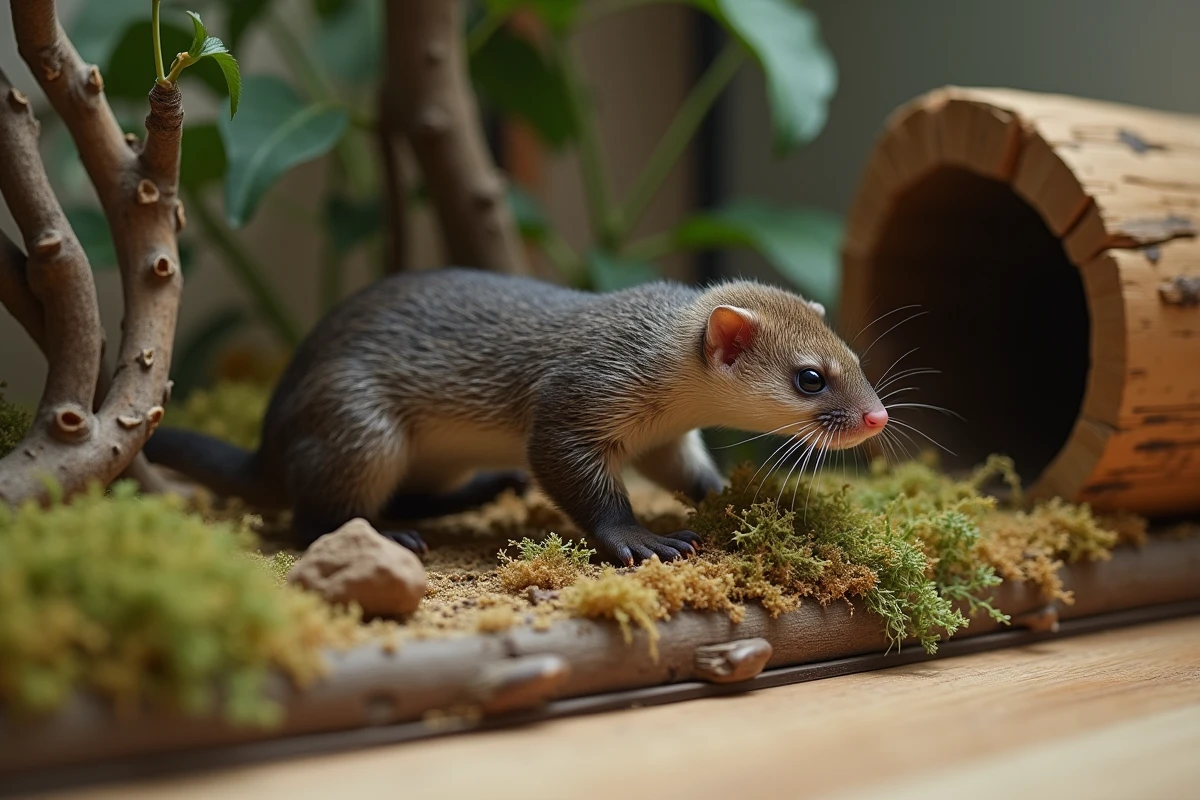
Its slender body, which rarely exceeds twenty centimeters including the tail, is designed to burrow into the tunnels of voles. We are talking about the smallest carnivore in North America (and one of the smallest in the world). An animal of this size burns a disproportionate amount of energy relative to its weight, which implies frequent meals, primarily consisting of live prey.
In practice, feeding a pygmy weasel in captivity poses concrete problems:
- Its diet relies on whole rodents, consumed several times a day, making sourcing logistically complicated for an individual
- The stress of captivity in such an active and territorial animal generates stereotypical behaviors (repetitive pacing, self-mutilation) documented in other small captive mustelids
- The pygmy weasel bites, and its bites, proportionally powerful for its size, are not “nips” comparable to those of a hamster
A ferret adapts to indoor life because generations of selection have prepared it for this. The pygmy weasel has never undergone this process. Comparing the two is akin to comparing a domestic cat and a wild Scottish cat.
Animal welfare and pygmy weasel: the concrete limits of a domestic environment
Even in a hypothetical scenario where ownership would be allowed, creating a suitable space poses challenges that online videos never address. The pygmy weasel needs to hunt to maintain its behavioral balance. We are not talking about optional enrichment, but a fundamental need related to its metabolism.
Its natural territory covers a variable area depending on available resources, but is significantly larger than what a domestic enclosure can offer. Confining a hyperactive predator in a restricted space guarantees behavioral issues.

Feedback varies on this point among the few facilities that house wild mustelids (rehabilitation centers, animal parks), but one observation consistently arises: these animals do not “calm down” over time. Unlike a ferret that eventually adopts a rhythm of prolonged naps, the pygmy weasel remains in almost constant motion during its waking phases.
Legal alternatives to wild companion animals: what surprising pets to adopt
The appeal of the pygmy weasel reflects a genuine desire for original pets. Rather than turning to a protected species ill-suited to domestic life, several legal companion animals offer an equally exotic experience:
- The ferret, which shares the silhouette and curiosity of mustelids while being domesticated and adapted to human cohabitation
- The domestic rat, whose intelligence and learning ability often surprise first-time adopters
- The chinchilla, a crepuscular animal with spectacular fur, which requires a specific environment but is perfectly feasible in an apartment
These species benefit from regulated breeding channels, veterinarians trained in their pathologies, and a community of owners who share reliable experiences. For the pygmy weasel, none of this exists on the individual side.
The fascination for small wild carnivores is understandable, especially when social media algorithms highlight spectacular hunting sequences. Admiring the pygmy weasel in its natural habitat remains the only respectful approach to the animal and the regulations. For those seeking an original companion, the legal framework already offers widely underestimated options.