
The national identity card (CNI) is issued free of charge in France for a first application or a standard renewal. This free service, often highlighted, masks additional expenses that increase the actual cost for some applicants.
Understanding what the price and cost of the identity card entails requires distinguishing the nominal price set by the state from the peripheral fees borne by each user.
Free CNI: what the official price exactly covers
The principle is simple: the production, processing, and issuance of the national identity card do not generate any tax stamp during a first application or a renewal with the return of the old card. The validity is set at 15 years for adults and 10 years for minors.
This free service also applies when the CNI is renewed early to access digital identity, a reason recognized only recently. However, early renewal is still subject to conditions, including the presentation of the old card.
In case of loss or theft, the situation changes. A 25 euro tax stamp is required to finance the production of the duplicate. This stamp can be purchased online at timbres.impots.gouv.fr or from an authorized tobacconist. No other official tax is added.
Hidden costs of the identity card: photo, travel, assistance

The Court of Auditors, in its March 2024 communication on the issuance of identity documents, points out indirect expenses borne by users that are not regulated by the state. These costs often go unnoticed in administrative guides.
Compliant identity photo
The photo must meet specific standards (light background, neutral expression, calibrated dimensions). A visit to an authorized photo booth or a professional photographer represents a variable expense depending on the providers and geographical location. Automatic booths remain the least expensive option, but some town halls refuse them if the result does not meet quality criteria.
Travel to the equipped town hall
Not all town halls have a collection device (biometric station). The Court of Auditors highlights a significant territorial disparity in access to appointments. In rural or suburban areas, traveling to an equipped municipality can involve several dozen kilometers, transportation costs, and sometimes taking a day off.
This logistical cost constitutes a “hidden surcharge” for users far from urban centers, even though the CNI’s official price remains zero.
Online assistance services
Private platforms offer to pre-fill the application, verify the compliance of documents, or make appointments on behalf of the applicant. These billed services are not mandatory. The pre-application can be completed for free on the website of the National Agency for Secure Documents (ANTS).
Supporting documents and application rejections: a factor of indirect cost
An incomplete or non-compliant application requires making another appointment, which extends the waiting times and multiplies the trips. The most common reasons for rejection concern proof of residence and the identity photo.
The Justif’adresse system, governed by articles R113-7 and R113-8 of the Code of Relations between the Public and the Administration, allows town halls to verify the address directly with operators (energy suppliers, telecom operators). This mechanism reduces rejections related to an expired or deemed insufficient proof.
To limit back-and-forth trips, here are the documents to gather before making an appointment:
- The Cerfa pre-application form, ideally completed online on the ANTS website to obtain a pre-application number
- An identity photo taken within the last six months, compliant with current standards (size 35 x 45 mm, bare head except for framed religious exceptions)
- A proof of residence dated within the last year (utility bill, tax notice, accommodation certificate accompanied by an ID of the host)
- The old CNI in case of renewal, or the declaration of loss/theft if applicable
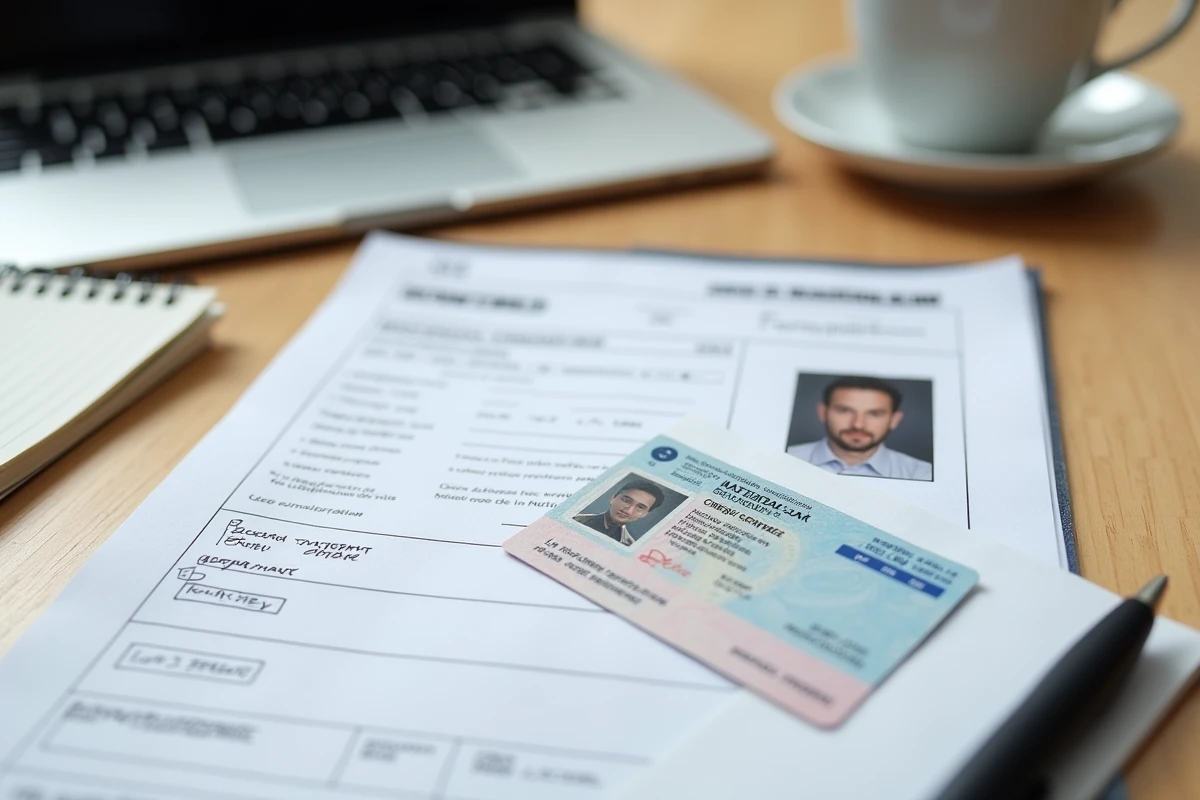
CNI in credit card format and digital identity: what changes for the cost
Since 2021, the new CNI adopts a credit card format with an electronic chip. This change in format does not alter the cost for the user. The free service remains the same, and the tax stamp in case of loss or theft remains at the same amount.
The integrated chip opens access to the France Identité application, which allows storing a digital version of the CNI on a compatible phone. This certified digital identity can be used to authenticate via FranceConnect for online procedures (taxes, health insurance, local authorities).
The early renewal to obtain the new chip format remains free, provided the old card is returned. This option avoids waiting for the expiration date to access the associated digital services.
Summary table: actual cost according to the situation
| Situation | Tax stamp | Possible additional fees |
|---|---|---|
| First application (adult or minor) | Free | Photo, travel |
| Renewal with return | Free | Photo, travel |
| Early renewal (digital identity) | Free | Photo, travel |
| Loss or theft | 25 euros | Photo, travel, declaration |
The identity card remains one of the few official documents whose nominal cost is zero for most situations. The actual additional costs depend on the distance to the nearest collection point and the number of attempts needed to compile a compliant application. Anticipating the preparation of documents and using the online pre-application on the ANTS website remains the most effective lever to reduce these indirect expenses.